What Is AI SEO? A Simple Explanation

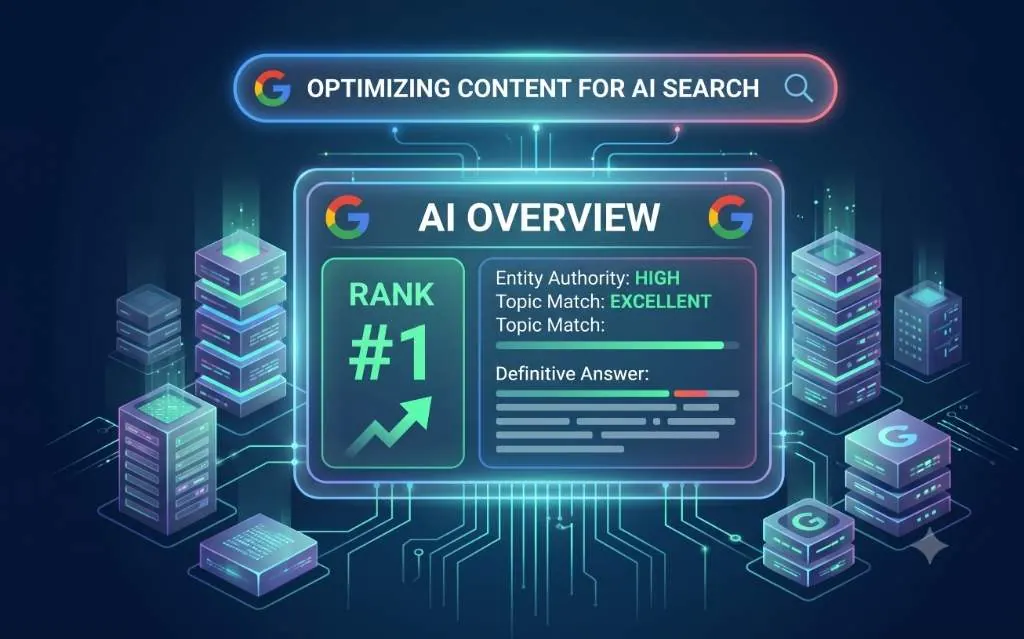
AI SEO is the practice of making your website's content easy for AI systems, like Google AI Overviews, ChatGPT, and Perplexity, to find, understand, and cite in their answers. It builds on traditional SEO (technical health, good content, real authority) but adds a new goal: getting picked as the source behind an AI-generated answer, not just ranking as a blue link.
Search used to work one way: you typed a query, Google returned ten blue links, and you clicked one. That's no longer the whole story. A large and growing share of searches now end with an AI-generated summary sitting above (or instead of) the traditional results. If your content isn't structured in a way AI systems can pull from, you can be doing everything right by old SEO standards and still be invisible in the answer that actually gets read.
- AI SEO is about getting cited inside AI Overviews, ChatGPT and Perplexity answers, not just ranking in the blue links.
- It extends traditional SEO rather than replacing it. AI systems still lean on classic ranking signals.
- GEO, AEO and LLMO all sit under the AI SEO umbrella and share the same fundamentals.
- Clear structure, factual accuracy and well-defined entities make content easier for AI to cite.
- Track citation frequency and brand mention accuracy alongside rankings and traffic.
Why This Is Suddenly Everywhere
A few numbers explain the urgency:
- Google's AI Overviews now appear on a meaningful and rising share of searches, up sharply from where they sat even a year ago.
- Research from SparkToro found that more than half of Google searches in the US now end without a click to any website, because the answer is already on the results page.
- ChatGPT alone now accounts for the large majority of all AI-referral traffic to websites, more than every other AI platform combined.
Put simply: people are getting answers without visiting your site, and the AI doing the answering is choosing who gets credited. AI SEO is how you influence that choice.
AI SEO vs. Traditional SEO
| Traditional SEO | AI SEO | |
|---|---|---|
| Goal | Rank in the top 10 blue links | Get cited or summarized in an AI-generated answer |
| Unit of competition | The whole page | A specific passage or paragraph |
| What's rewarded | Keywords, backlinks, page authority | Clarity, factual precision, entity consistency |
| Success signal | Ranking position, click-through rate | Citation frequency, mention accuracy, share of AI answers |
| Content style | Can be broad and comprehensive | Rewards short, scoped, self-contained answers |
Neither replaces the other. AI systems still lean heavily on traditional ranking signals to decide which pages are even worth considering - one widely cited estimate puts the overlap between AI Overview citations and existing top-20 organic rankings at well over 90%. AI SEO is best understood as traditional SEO's fundamentals, extended to a new kind of reader: a language model instead of a human scanning a page.
Our serviceAI search visibilityGet your practice named when patients ask ChatGPT, Gemini and AI Overviews.The Confusing Acronym Soup: GEO, AEO, and LLMO
If you've seen these terms thrown around, here's the short version of what each one actually means:
| Term | Full name | What it targets |
|---|---|---|
| GEO | Generative Engine Optimization | Getting your content selected and synthesized into AI-generated summaries (Google AI Overviews, Perplexity, Copilot) |
| AEO | Answer Engine Optimization | Getting your content extracted directly as a concise answer (featured snippets, voice assistants, FAQ-style results) |
| LLMO | Large Language Model Optimization | Getting your content absorbed into what a model "knows" and references when generating any answer, not just search results |
All three sit under the umbrella of AI SEO. You don't need to treat them as separate campaigns. In practice, the same fundamentals (clear structure, factual accuracy, defined entities) improve your odds across all of them at once. We detail our exact approach to this on our AEO services page.
How AI Search Actually Decides What to Cite
AI systems don't "rank" content the way Google's classic algorithm does. Most of them work through a process closer to this:
- Retrieve a set of candidate sources for the query (often pulling from existing top-ranking pages).
- Extract the most relevant, self-contained passages from those sources.
- Synthesize those passages into a single answer, choosing which sources to cite along the way.
This means a page can rank well in Google and still get skipped entirely by an AI answer, if the useful information is buried in the fourth paragraph, tangled up with unrelated content, or never stated clearly enough to lift out. The practical implication: write the answer as if it needs to survive being copied into a different context, on its own, with no surrounding page for support.
How to Actually Do AI SEO
You don't need a separate strategy from good SEO. You need to sharpen a few specific habits:
- Answer the question in the first few sentences. Don't build up to the point. State it, then support it. AI systems favor content where the answer doesn't require reading the whole page to find.
- Keep pages scoped to one topic. A single page trying to cover ten related questions produces messy, hard-to-extract content. Narrower, focused pages tend to perform better in AI answers than sprawling pillar pages, even when the pillar page ranks fine in classic search. Our dental SEO approach covers how to structure this for procedure pages.
- Use real structure. Clear headings, short paragraphs, and lists aren't just good UX, they're what makes a passage easy for a model to lift cleanly. Walls of unbroken text are the easiest thing to skip.
- Add schema markup. FAQ, Article, HowTo, and Organization schema give AI systems explicit, structured signals about what your content is and how it's organized. It doesn't guarantee a citation, but it removes ambiguity.
- Be specific and factual, not vague. Concrete numbers, named sources, and defined terms are more citable than generalizations. "Many businesses see results" is forgettable. "Most businesses see traction within 3 to 6 months" is quotable.
- Build real topical depth. AI systems (like Google's own ranking systems) still reward genuine expertise. A handful of thin pages targeting different keywords won't out-compete a smaller number of genuinely thorough ones written by someone who clearly knows the subject.
- Keep content current. AI systems tend to favor freshness on anything time-sensitive. A page that hasn't been touched in two years, with outdated figures, is an easy one to leave out of a synthesized answer.
- Earn real mentions elsewhere. Brand mentions, press coverage, and links from credible sites help AI systems verify who you are before they trust you enough to cite you. This is still, in large part, digital PR and link building by another name.
Common Mistakes to Avoid
- Treating it as a completely separate discipline from SEO. It's an extension, not a replacement. Neglecting technical SEO or content quality to chase "AI tactics" backfires.
- Publishing more content, faster, without improving accuracy. Volume doesn't help if the content is vague or generic. AI systems reward precision over quantity.
- Chasing keyword density instead of clarity. Generative systems work on meaning, not keyword matching. Repetition doesn't move the needle the way it once did.
- Judging success only by traffic. You can gain real visibility and brand exposure from an AI citation with zero click-through. Track mentions and citation frequency too, not just visits.
- Trying to write "for the algorithm." There's no secret formula or magic phrase. Clear, accurate, well-organized content written for actual humans is also what performs best for AI systems.
How to Measure Whether It's Working
Traditional rankings and traffic still matter, but they don't tell the whole story anymore. Also keep an eye on:
- Citation frequency: how often your content shows up, cited or paraphrased, inside AI Overviews, ChatGPT, or Perplexity answers for relevant queries.
- Brand mention accuracy: whether AI tools describe your business, products, or services correctly when asked about them.
- AI-referral traffic: the (currently smaller but growing) segment of visits arriving from AI platforms directly, visible in most modern analytics tools.
- Share of voice: how often you're cited relative to your direct competitors for the same set of queries.
Sources
- SparkToro / Rand Fishkin, 2024 Zero-Click Search Study: found 58.5% of US Google searches end without a click. sparktoro.com
- Search Engine Land, ChatGPT commands 92% of AI referral traffic, 2026 analysis of AI referral session data.
- Google Search Central, official documentation on AI Overviews and AI Mode ranking guidance. developers.google.com
The Bottom Line
Want your business showing up when people ask ChatGPT, Perplexity, or Google AI Overviews for a recommendation, not just when they scroll through search results? That's the core of what we do at GetLocably. Get in touch if you want a clear-eyed read on where your content stands today.
Frequently asked questions
Not entirely. AI SEO builds on the same foundation - technical health, quality content, real authority - but adds a specific focus on being cited inside AI-generated answers, not just ranking as a link.
Yes, but less than they used to. Keywords still help signal relevance and intent, but AI systems weigh clarity, structure, and factual accuracy far more heavily than exact keyword matching or density.
AI SEO is the umbrella term. GEO (Generative Engine Optimization) focuses on getting synthesized into AI summaries. AEO (Answer Engine Optimization) focuses on getting extracted as a direct answer. Most practical work improves your odds at both simultaneously.
No. AI systems still lean heavily on traditional ranking signals to decide which sources are even worth considering, so strong classic SEO remains the foundation everything else is built on.
It varies, but early citation gains are often visible within weeks of adding clear structure and schema to a page, faster than typical ranking timelines, since AI systems can pick up well-structured content quickly once it's crawled.